Climate Change
Transition plan for climate change mitigation
ESRS E1-1
Alpiq has set itself the target of reaching net zero Scope 1 and 2 emissions by 2040. In accordance with the Swiss Climate Ordinance (see SCO index in the Appendix), Alpiq’s CO2 descent path for the existing electricity generation portfolio is visible below:
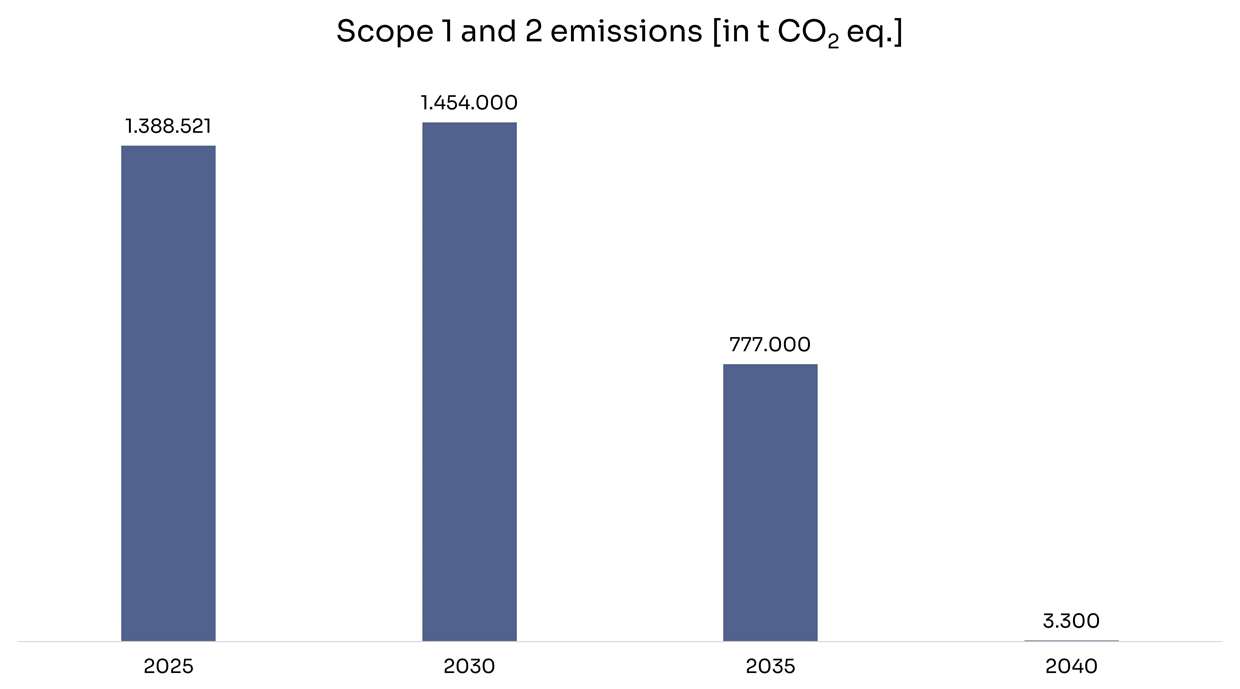
Potential future investments in flexible assets (pumped hydropower, BESS and gas power plants) are not reflected in the CO2 descent path. Alpiq will rebalance the transition plan when future investments in these technologies actualize. At present Alpiq continuously analyses new solutions and technologies that could contribute to the goal of fossil-free power production. Additionally, Alpiq deploys certified management systems in accordance with each specific production technology and country regulatory frameworks to track the effectiveness of its progress in limiting emissions. This is achieved by monitoring production activities and performance to limit GHG and air pollutant emissions.
The primary lever of Alpiq’s decarbonisation efforts lies in the management of its gas power plants, which currently represent the largest share of the company’s direct emissions. Some emissions reductions are expected between 2030 and 2035 as gas power plants gradually shift their operation patterns towards peaking or high-capacity, shorter-duration operation, rather than mid-merit generation.
The operating licences for all existing gas power plants are scheduled to expire before 2040, marking a key milestone in reducing Alpiq’s carbon footprint. In specific cases, these facilities play an essential role in ensuring security of supply, and their decommissioning requires formal authorization from the transmission system operator. In such situations, the timing of plant closure is determined by system‑level reliability needs.
Furthermore, Alpiq continuously strives to optimise the efficiency of its gas power fleet by adopting the latest available technologies, such as turbine upgrades, to maximise performance. While this leaves limited scope for further efficiency gains, Alpiq remains committed to exploring innovative pathways, including hydrogen (H₂) blending and biogas sourcing, thereby reaffirming its commitment to achieving future greenhouse gas reduction targets.
Although gas power plants account for more than 99% of Group Scope 1 and 2 emissions, Alpiq also assumes responsibility for reducing GHG emissions from other sources. This is achieved through the continuous optimisation of asset performance and the upgrading of equipment, such as pumps and turbines in hydropower assets, as well as the implementation of energy efficiency measures to reduce consumption.
Ultimately, the marginal emissions projected for 2040 will mainly result from cycle losses in Alpiq’s pumped-hydropower plants and efficiency losses from battery charging cycles as well as from direct emissions relative to dam lakes. In particular, Alpiq’s share of electricity used for pumping in hydro, charging in BESS and internal services consumption, affects Scope 2 emissions through the respective country’s GHG grid emission factor. For the time being, Alpiq envisages addressing the compensation of residual emissions through guarantees of origin.
Material impacts, risks and opportunities
ESRS 2 SBM-3
The following section outlines how Alpiq assessed physical and transition risks related to climate change. According to the TCFD framework, physical risks stem from the direct impact of climate change – either acute (event-driven) or chronic (long-term shifts in climate patterns) – and may lead to financial consequences such as asset damage, supply chain disruptions, or operational interruptions. Transition risks arise from the shift to a low-carbon economy through policy, legal, technological, or market changes, and can create both financial and reputational impacts. Gross risks refer to risks identified before mitigation measures, while net risks represent residual risks after mitigation.
To strengthen climate resilience, Alpiq continuously reviews and adapts its strategy, focusing on:
- Flexibility: investing in flexible generation and storage capacity to manage variability and extreme weather.
- Hydropower: expanding capacity to leverage changing water inflows and ensure winter supply security.
- Low-impact technologies: investing in solutions such as BESS.
- Trading: enhancing capabilities to respond quickly to market changes.
- PPAs: partnering with industrial clients to decarbonise operations and secure energy supply.
Recent natural disasters near Alpiq’s Swiss assets, such as the 2024 flooding in Valais and the 2025 Blatten landslide, underscore the ongoing relevance of climate-related risks. Alpiq and its partner entities conduct annual risk assessments that integrate climate change impacts. These consider, for example, risks to water intakes, increased sedimentation, plant flooding and blockage of access routes. To ensure continued compliance with the Swiss Federal Office of Energy’s C2 directive on dam flood safety, Alpiq will closely review the revised version expected to enter into force in 2027.
New projects, such as the Gornerli dam, incorporate resilience measures from the outset. Designed as a multifunctional asset, the dam will, in addition to providing approximately 650 GWh of winter electricity, manage meltwater from the retreating glacier, mitigate hydrological risks, enhance flood protection, and support drinking water and irrigation reserves.
In contrast, transition risks are expected to have a greater impact on Alpiq, as transition-related events may influence energy and CO2 prices, which in turn have a direct impact on the company’s cash flow.
Identification process for impacts, risks, and opportunities
ESRS 2 IRO-1
In 2024, Alpiq conducted a climate scenario analysis to assess physical and transition risks. Physical risks were analysed for Alpiq’s own operations and selected upstream assets, while transition risks covered the entire value chain. The analysis represents an initial step towards a full climate resilience assessment.
Physical risks
The scenario analysis indicates that Alpiq is well protected against physical risks, as its plants meet exceptionally high safety standards, maintained through continuous investment and adaptation to the latest model calculations and regulations. For instance, Alpiq’s hydropower plants are designed to withstand 1,000-year flood events (0.1% annual probability). Nevertheless, lower intensity floods do result in short to medium term outages linked to sediment loads, blocked water intakes or downstream flood impacts, for example to transmission lines. Associated production losses are mitigated across the Alpiq hydropower asset portfolio and offset through Trading division operations.
For the analysis, Alpiq used the Munich Re Location Risk Intelligence Tool to identify climate-related physical hazards across its own operations and selected upstream assets (minority shareholdings). The tool assesses hazard probability across four time horizons (current, 2030, 2050, and 2100) and three climate scenarios (Intergovernmental Panel on Climate Change (IPCC) SSP1, SSP2, and SSP5) based on each asset’s type and location.
Scope 1 and 2 emissions net zero goal by year
2040
Out of 126 assessed locations, 31 high-risk sites were analysed in greater detail. The main current and potential hazards identified include cold and drought stress, extreme storms, fire, flash floods, hail, landslides, river floods, precipitation stress, and water stress, with flooding and landslides deemed the most relevant.
Each asset’s exposure and physical risk were evaluated under the three IPCC scenarios:
- SSP1: low emissions, < 2 °C warming
- SSP2: medium emissions, 2 – 3 °C warming
- SSP5: high emissions, 3.3 – 5.7 °C warming
These scenarios, used in the IPCC Sixth Assessment Report, provide a robust basis for assessing risk probabilities and severities. As mentioned above, many mitigation measures are already integrated into Alpiq’s asset design; therefore, the calculated risks represent residual physical risk. The probability of occurrence of different climate events and the estimated number of shutdowns for each asset served as inputs for estimating the financial impact of physical risks.
The following physical risks were identified as material:
Number of Alpiq locations assessed regarding climate-related material hazards
126
Physical risk | Description | Time horizon 1 | Impact | Sensitivity (expert opinion) 2 |
Flooding (acute) | Potential intensification of flood events due to climate change | M, L | Potential damage to Alpiq’s operations, including potential infrastructure damage, and business interruption in affected regions. Recovery costs, operational shutdowns, and difficulty in meeting customer demands for electricity and services. | Very low |
Landslide (acute) | Extreme weather events such as excessive rainfall and increasing temperature can trigger landslides | M, L | Potentially strong impact on Alpiq’s operational portfolio, particularly in areas where the company has critical infrastructure, facilities, or employees. Infrastructure damage and potential extended business interruption periods could result. Loss of revenues, increased maintenance costs, and lower production capacity and services in affected areas. | Medium |
Precipitation stress (chronic) | High precipitation volumes due to climate change | L | Adverse effects on Alpiq’s regional operations. Excessive rainfall may induce floods and landslides or hail events that may cause damage to equipment and power transmission lines. | Very low |
1S = Short Term, M = Medium Term, L = Long Term
2The expert opinion regarding sensitivity is based on inputs from Alpiq internal experts as well as from an independent external advisor.
The impacts described in the table could lead to reduced production capacity and production rates, increased overhead costs, and a deterioration of market position, all of which could adversely affect the company’s profitability. However, as mentioned previously, many adaptation measures are already inherent to Alpiq’s assets.
In 2025, Alpiq complemented the physical risk assessment with a focused study on water and biodiversity risks, using the WWF Risk Filter Suite in addition to the Munich Re tool, for the same assets. Further details on these assessments can be found in the chapters Water and Marine Resources and Biodiversity.
Transition risks
Climate-related transition risks and opportunities across Alpiq’s operations and value chain were assessed in 2024 under a 1.5 °C scenario (IEA Net Zero 2050), representing the most stringent and regulator-relevant case.
Gross transition risks and opportunities were identified through a qualitative assessment of potential events in the following clusters:
- Risks: Political & Legal, Technology, Market, Reputation
- Opportunities: Resource Efficiency, Energy Source, Products & Services, Markets, Resilience
Internal experts evaluated the impact and likelihood of each event across short-term (1 year), medium-term (2–5 years), and long-term (> 5 years) time horizons.
The following material transition events and related gross risks were identified:
Transition risk cluster | Description | Time horizon 1 | Impact | Sensitivity (expert opinion2) |
Market | The market risk in the energy sector is influenced by a shift towards cleaner energy sources, a decrease in fossil fuel energy demand, and the establishment of new energy companies solely focused on clean energies. | L | The transition affects the return on investment (ROI) and compliance costs, as companies may need to decommission existing fossil fuel infrastructure and adhere to strict environmental standards. It may also impact market share, potentially leading to a reduction in the market share of existing companies. Shifting investment patterns may occur as investors prioritise companies with strong sustainability credentials. | High |
Policy & Legal | The policy and legal risks are associated with evolving regulatory frameworks targeting GHG emissions. These include stricter emissions regulations, reduced government support for fossil fuels, and mandates for transitioning to low-carbon energy systems. | L | Changed regulation may impact operational compliance requirements and compliance costs, influence energy market dynamics, shift customer and stakeholder expectations toward more sustainable practices, and lead to subsidy reductions and regulatory penalties. | Medium to high |
Reputation | Reputation risks stem from the public perception of fossil fuel reliance, lagging sustainability efforts and slow adaptation to new technologies. | L | Negative public sentiment can lead to the erosion of trust, a diminished brand value, difficulties attracting customers and investors, and a failure to attract talent, which in turn negatively impacts the market position. | Medium to high |
Technology | Technological challenges may arise due to (and not limited to) implementation of new technologies, uncertainty in renewables technology, energy storage technology limitations and interoperability and compatibility issues of assets. | L | Technological challenges may lead to increased costs and lower cost effectiveness, as well as a competitive disadvantage. | Medium to high |
1S = Short Term, M = Medium Term, L = Long Term
2The expert opinion regarding sensitivity is based on inputs from Alpiq internal experts as well as from an independent external advisor.
The potential impacts described in the table above could lead to a decrease in revenues and profitability.
The following transition events and related opportunities were identified as material (by cluster):
Transition opportunity cluster | Description | Example | Time horizon 1 | Impact |
Products & Services | Leverage innovation in energy storage, renewable energy trading, and AI-driven solutions to lead the sustainable energy market and drive revenue growth. | Deploy advanced storage solutions, expand renewable trading platforms, and integrate AI to enhance trading efficiency and drive revenue growth. | M to L | Very high |
Markets | Expand capacity to meet growing demand for renewable and green energy while capitalising on the market shift toward low-carbon solutions and green investments. | Expand hydropower, wind and photovoltaic capacities and other green energy sources, issue green bonds to attract sustainable investment and drive project growth. | L | Very high |
Resilience | Position climate resilience as one of the most important aspects in business strategy to adapt proactively, build trust and align with emerging sustainability trends for long-term growth. | Embed climate risk assessment into planning processes, align capital expenditure with sustainability goals, and partner with governments and organisations to drive regional adaptation initiatives and strengthen market positioning. | L | High |
Ressource Efficiency | Further invest in leading sustainable resource management practices and continuously enhance operational efficiency by implementing advanced technologies and optimising processes. | Adapt advanced technologies such as smart grids, optimise water usage, reduce waste, collaborate with stakeholders in the value chain, and educate staff on best practices in resource management. | L | High |
Energy Source | By expanding the renewable energy portfolio, including making further investments in hydropower, wind, solar and flexibility projects, Alpiq can align more closely with global decarbonisation goals and sustainability targets, save costs and grow revenue from energy sources. | Ongoing investment in the latest technologies and processes to continuously improve the efficiency of all renewable energy operations. | L | High |
1S = Short Term, M = Medium Term, L = Long Term
The table above illustrates that transition events not only present risks but can also create significant opportunities for Alpiq, which may positively impact market valuation, financing conditions, costs, and revenues.
A qualitative assessment of transition risks provides a solid baseline for better understanding the potential impacts of the transition to net zero and for exploring the potential associated opportunities. However, due to the complexity of transition risks and in order to gain a more comprehensive understanding of the financial implications they might entail, Alpiq quantified both the risks and opportunities associated with a transition to net zero. The impact on the company’s financials was modelled using an in-house financial model across three climate scenarios (base case, RCP 2.6, and RCP 8.5). The model results indicate that climate change has an impact on financial performance; however, the magnitude and direction of this impact are largely dependent on market price trends.
Policies related to climate change mitigation and adaptation
ESRS E1-2
Alpiq currently does not have a Group-level environmental policy to harmonise its environmental principles and objectives across locations and activities. Nevertheless, Alpiq’s energy production assets in Hungary, Italy, and Spain, as well as the hydropower business unit in Switzerland, are certified under the International Organization for Standardization (ISO) 14001 Environmental Management System. Across all gas power plants in Italy and Spain, the Eco-Management and Audit Scheme (EMAS) is also implemented. These systems address long-term environmental management practices in the context of climate change mitigation, with a strong focus on continuous improvement.
Gross Scopes 1, 2, 3 emissions, total GHG emissions, and GHG intensity
ESRS E1-6
Consolidation method
Alpiq has reported its Scope 1, 2, and 3 GHG emissions in accordance with the GHG Protocol Corporate Accounting and Reporting Standard, since 2020. Until 2023, the methodology was solely based on Alpiq’s equity share of its assets, following these principles:
- All direct emissions reported as Scope 1.
- For all majority assets (> 50% share), indirect emissions reported as Scope 2.
- For all minority assets (< 50% share), indirect emissions reported as Scope 3.
In all cases, values were reported in proportion to the respective ownership shares of the asset.
The 50% shareholding criterion was originally intended to reflect Alpiq’s degree of influence on the assets, considered as “fixed asset investments” in the GHG Protocol nomenclature. This is a simplified view assuming the parent company has no influence on the assets and that only dividends are received. In practice, Alpiq has energy procurement rights and reports electricity production corresponding to shares in assets, regardless of the percentage owned. This is better aligned with the “associated/affiliated companies” category in the GHG Protocol. Hence, from 2025, this 50% share distinction was removed and equity share emissions applied to Scope 1, 2 and 3 emissions. Values for 2024 presented in this report also reflect this change.
The ESRS guidelines define an alternative consolidation principle based on operational control. Assets under operational control are defined as fully consolidated entities for which Alpiq has the authority to introduce and implement operating policies. This consolidation method requires:
- All fully consolidated assets to be reported under Scopes 1 and 2 (100% of emissions).
- All non-fully consolidated assets to be reported under Scope 3 (values proportional to ownership shares).
The ESRS consolidation method was first reported in 2024 to align with CSRD requirements and significantly affects the reported GHG balance of Alpiq’s activities. Most of Alpiq’s assets in Switzerland are partner plants (so-called “Partnerwerke” in German) held as minority shareholdings, in some cases governed by specific contractual arrangements. Under the operational control approach, these assets are not fully consolidated, even where Alpiq holds a management mandate. This results in a notable reporting gap, as some major energy production assets fall outside any shareholder’s direct scope.
Alpiq considers that all assets under its management are core parts of its activities and that the equity share consolidation method therefore provides a more representative view of its overall business. Consequently, Alpiq continues to report GHG emissions using the equity share approach in parallel with the strict ESRS operational control method. Both methodologies are presented in the following sections.
Standards, methodologies, assumptions and calculation tools used
The 2025 calculation process and GHG declaration were conducted according to the GHG Protocol and the 2023 ESRS E1 requirements. Furthermore, they were checked externally by a third-party expert.
GHG emissions of gas power plants are based on indirect site measurements and are reported in the relevant national registries. The other principal sources of GHG emissions include energy consumption at power plants and owned office buildings. Vehicle emissions are calculated based on reported kilometers travelled by Alpiq employees. Upstream and downstream emissions related to trading activities (physical deliveries of power and gas) are calculated based on reported sales volumes.
Emissions coefficients are updated annually, based on the most recent and approved references in consultation with the external expert, as follows:
- Emissions factor, fuel consumption: BAFU, Faktenblatt
CO2-Emissionsfaktoren des Treibhausgasinventars der Schweiz, April 2025
– Switzerland’s greenhouse gas inventory (admin.ch) - National average emissions factors, European Residual Mixes 2024
Association of Issuing Bodies: Table 4: Total Supplier Mix 2024 – 2024 | AIB - Emissions factor by technology, power generation: Treibhausgas- Emissionsfaktoren für den Gebäudesektor, intep, 26.02.2024, V2.0 –Emissionsfaktoren für den Gebäudesektor (intep.com)
- Conversion factor for mobility, km to energy: Mobitool 3.1 – Weitere Informationen über den Umweltrechner Verkehr
- Scope 3 emission factor, nuclear – EDF lifecycle analysis of EDF’s nuclear kWh
- Location-based emission factor for Swiss electricity mix 2023 – REIDA Treibhausgasemissionsfaktoren
- Electricity generation mix for certain European countries – Our world in data – Electricity Mix
For internal purposes, to guarantee consistency from year to year, energy consumption and the respective GHG emissions are evaluated for each production site, office building and business unit.
Base data is collected from various internal data owners using specific checklists. Calculations are performed using an Excel-based tool originally developed by an external consultant and updated internally each year to include newly identified emission sources.
The declaration is provided in CO2 equivalents, including all applicable greenhouse gases. The emissions are based on the most recent and approved reference coefficient factors, which include all main gases with known GHG effects, according to the requirements of the UNFCCC/Kyoto Protocol: carbon dioxide (CO2), methane (CH4), nitrous oxide (N2O), hydrofluorocarbons (HFCs), perfluorocarbons (PFCs), sulphur hexafluoride (SF6), and nitrogen trifluoride (NF3).
Notably, several methodology updates were implemented in 2025.
Firstly, direct emissions related to hydropower production, both storage and run of river, were considered according to recent studies, based on technology-specific Scope 1 emission factors. The calculation was updated to reflect Alpiq’s effective electricity production, and the methodology was retroactively applied to 2024 to ensure comparability across reporting periods.
Secondly, Scope 2 and 3 calculations related to pumped-hydro storage were amended. Previously, emissions associated with all the electricity purchased from the grid and used for pumping were allocated to Alpiq’s Scope 2. However, the GHG Protocol specifies that electricity purchased for resale to end users should not be included in Scope 2 emissions but are reported in Scope 3 instead. Accordingly, Alpiq’s Scope 2 emissions associated with pumping and turbining now include only internal services consumption and cycle losses, in alignment with national declarations of origin.
Similar considerations apply to BESS, of which Alpiq commissioned its first unit in 2025 (Finland). For BESS, the Scope 2 calculation considers the effective cycle losses of system: the difference between the effective grid charging and discharging amounts. The electricity re-injected to the grid is included in Scope 3.
Scope 1 GHG emissions including share in emissions trading schemes (ETS)
Scope 1 emissions cover direct emissions from stationary and mobile combustion as well as fugitive or process emissions. Regarding Alpiq’s activities, electricity production from gas-fired power plants is the main source of direct emissions. Scope 1 emissions of Alpiq’s gas-fired power plants are aligned with their respective national registry declarations. Emissions resulting from the fuel consumption of buildings and vehicles owned by the company and direct emissions from dam lakes and rivers are also included.
Change in Scope 1 emissions (vs. 2024 - ESRS value)
–12%
ESRS consolidation | Equity share | ||||
Scope 1: direct GHG emissions [T CO2 eq] | 2025 | 2024 | 2025 | 2024 | 2023 |
Gas-fired power plants | 1,377,551 | 1,558,126 | 1,231,915 | 1,415,481 | 1,313,498 |
Other power plants1 | 2,256 | 3,2062 | 8,036 | 8,8122 | 470 |
Mobility in Europe (vehicle fleet owned or leased by Alpiq, fossil fuelled) | 227 | 229 | 227 | 229 | 294 |
Administrative buildings in Europe owned by Alpiq | 485 | 431 | 485 | 431 | 417 |
Direct (Scope 1) GHG emissions gross | 1,380,519 | 1,561,992 | 1,240,663 | 1,424,953 | 1,314,679 |
Share included in regulated Emission Trading Schemes [%] | 100% | 100% | 100% | 100% | 100% |
1Fuel consumption (diesel generators, heating) reported for nuclear and hydropower assets since 2023, for RES assets since 2024
22024 and 2025 data include an updated methodology: application of technology-specific emission factors for hydropower production
The reduction in gas power plant emissions between 2024 and 2025 reached 11.6%, resulting in a comparable reduction in total Scope 1 GHG emissions
This was largely driven by the fact that gas power plant running hours depend on local market conditions, which differ each year. In 2025, Italian plants produced similarly to 2024, while the Hungarian plant saw reduced demand resulting in lower running hours. Finally, the Plana del Vent power plant in Spain underwent major maintenance operations, including a complete rewinding of the generator stator, resulting in a four-month plant outage. In terms of GHG intensity, gas power-related emissions are lower by approximately 2% compared to 2024.
Scope 1 emissions for other power plants decreased notably by close to 30% from 2024 to 2025, largely in alignment with reduced precipitations and inflows resulting in lower hydro production overall.
Scope 1 emissions of owned administrative buildings show a slight increase compared to the previous two years. Conversely, mobility-linked emissions are stable, maintaining the benefits of hybrid or full-electric vehicles instead of petrol or diesel.
Direct biogenic CO2 emissions
Alpiq activities include no significant combustion or biodegradation of biomass. Nevertheless, a few hydropower production sites use wood pellets for heating, which falls within the scope of biogenic emissions (out of scope from other GHG inventories, as produced from biologically-based materials). These sites are not within Alpiq’s operational control and are thus not included in the ESRS consolidation. Furthermore, a related emission factor was applied to run-of-river generation for data from 2024 onwards.
ESRS consolidation | Equity share | ||||
Scope 1: direct biogenic CO2 emissions [T CO2 eq] | 2025 | 2024 | 2025 | 2024 | 2023 |
Pellets heating | 0 | 0 | 212 | 149 | 194 |
Run-of-river | 22 | 28 | 30 | 37 | - |
Direct (Scope 1) biogenic emissions gross | 22 | 28 | 242 | 186 | 194 |
Under the equity share approach, biogenic emissions from pellets heating increased in 2025 due to increased heating demand. Fluctuations are expected with varying building occupancy, weather conditions as well as the monitoring approach, which is based on yearly fuel deliveries, not directly on the amounts consumed. For run-of-river production emissions, the year-on-year reduction is directly linked to smaller production in a drier year.
Scope 2 GHG emissions
Scope 2 covers indirect emissions from electricity consumption and district heating of power plants, leased buildings and all-electric vehicles. The declaration of Scope 2 emissions generally considers the location-based approach, which reflects the average emissions intensity of grids in which energy consumption occurs (using country or grid-average residual emissions factor data).
An effective market-based approach derives emissions factors from contractual instruments, which include any type of contract between two parties for the sale and purchase of energy bundled with attributes about the energy mix (through certificates or delivery contracts).
Alpiq’s electricity procurement, especially for its production assets, involves various and complex contracts, the majority of which do not specify a guarantee of origin. Consequently, only a marginal part of the electricity used to run Alpiq’s assets can be linked to a specific market-based energy mix and corresponding emissions factors. For this reason, only location-based data is reported below, with total market-based reductions according to documented guarantees of origin.
The gross energy indirect (Scope 2) GHG emissions in metric tons of CO2 equivalents can be found below:
Change in Scope 2 emissions (vs. 2024 - ESRS value)
–32%
ESRS consolidation | Equity share | ||||
Scope 2: indirect GHG emissions - location-based 1 [T CO2 eq] | 2025 | 2024 | 2025 | 20242 | 2023 |
Energy procurement for standby operation of gas-fired power plants | 6,673 | 9,939 | 6,112 | 9,275 | 8,172 |
Energy procurement for run-of-river, photovoltaic and wind power plants | 764 | 1,1403 | 771 | 1,1403 | 1,447 |
Energy for storage power plants (partner power plants) | 402 | 5144 | 2,334 | 3,7324 | 6,108 |
Energy for nuclear power plants and hydrogen generation | 0 | 0 | 1,726 | 168 | - |
Mobility in Europe (vehicle fleet owned or leased by Alpiq, electrically driven) | 7 | 5 | 7 | 5 | 3 |
Electricity consumption of administrative buildings in Europe owned or rented by Alpiq | 157 | 168 | 157 | 168 | 131 |
Indirect (Scope 2) GHG emissions gross | 8,002 | 11,766 | 11,107 | 14,488 | 15,861 |
Market-based reductions 5 | – 285 | – 32 | – 1,800 | – 115 | – 45 |
1Location-based: the calculations are based on reference country supplier mixes
2All values represent Alpiq’s equity share, 50% distinction for majority and minority ownerships removed
3Previously reported data for 2024 considered run-of-river power generation contributions, which have been adjusted to Scope 1
42024 data include an updated methodology for pumping-turbining: only internal services consumption and cycle losses are considered.
5Market-based: the market-based reductions are based on the effective energy mix when origination guarantee is available (certifications or chosen specific energy mix)
Global Scope 2 emissions show a 32% decrease compared to 2024. The main drivers of Scope 2 emissions reductions are:
- Reduced stand-by electricity consumption by gas-fired power plants, which depends on total running hours.
- Hydropower pumping consumption, which depends on the yearly natural intakes and production planning. 2024 and 2025 values are lower than 2023 values due to the change in methodology described above: only internal services and cycle losses are considered and 2025 production is lower overall.
- Variations of the average electricity consumption mix in countries with significant consumption, and related emissions factors
- The most significant contribution to market-based reductions is associated with the electricity used for hydrogen generation in Finland linked to a hydropower PPA with 0 operating emissions
Scope 3 emissions per category
Scope 3 covers all other indirect emissions that occur in Alpiq’s value chain, according to the GHG Protocol framework. A full assessment of Alpiq Scope 3 GHG emissions was conducted with the support of an external consultant in 2023. Based on this comprehensive assessment, this report addresses the most relevant emitting categories, which encompass over 98% of Group Scope 3 emissions. This includes the following categories:
- Indirect emissions from assets beyond operational control and electricity resold to end users (pumped-storage hydro and BESS)
- Category 3.3 – Upstream emissions relative to Alpiq’s own energy consumption as well as energy sold to end users
- Category 3.6 – Business travel emissions (flights, trains, rented and personal vehicles for business activities, train journeys for business unit Switzerland)
- Category 3.11 – Emissions originating from the end use of goods and services sold by Alpiq (gas sold to end users).
Notably, business travel Category 3.6 is included for internal environmental awareness even though it is not significant in terms of relative magnitude.
The gross other indirect (Scope 3) GHG emissions in metric tons of CO2 equivalents can be found below:
ESRS consolidation | Equity share | ||||
Scope 3: indirect GHG emissions [T CO2 eq] | 2025 | 2024 | 2025 | 2024 | 2023 |
Energy procurement for nuclear power, hydropower plants and hydrogen facilities | 12,473 | 18,0981 | 7,797 | 13,8961 | 11,844 |
Pump energy for pumped storage power plants (partner power plants) | 2,400 | 2,8992 | 5,872 | 6,9262 | 12,392 |
Cat 3.3 3 Other fuel and energy-related activities | |||||
Upstream emissions - own energy consumption (fuel and electricity) | 326,295 | 365,902 | 326,295 | 365,902 | 344,998 |
Upstream emissions - energy sale to end users (electricity) | 2,030,087 | 2,174,959 | 2,030,087 | 2,174,959 | 2,421,297 |
Cat 3.6 3 Business mobility | |||||
Flights - Switzerland and Europe | 879 | 911 | 879 | 911 | 624 |
Use of rented (CH & Europe) and personal cars (CH) for business activities | 91 | 58 | 91 | 58 | 93 |
Train journeys (Switzerland) | 15 | 25 | 15 | 25 | 22 |
Cat 3.11 3 Use of sold products | |||||
Sale of purchased gas to end users | 2,551,541 | 2,592,833 | 2,551,541 | 2,592,833 | 2,872,999 |
Indirect (Scope 3) GHG emissions gross | 4,923,781 | 5,152,186 | 4,922,577 | 5,155,509 | 5,664,269 |
Market-based reductions 4 | – 1,565 | – 83 | 0 | 0 | |
12024 data reflect updated methodology: application of hydro-production emission factor
22024 data include updated pumping-turbining cycle losses methodology
3Cat 3.3, 3.6, 3.11 are linked to Alpiq's corporate business activities, and are therefore not influenced by the production asset consolidation method.
4Market-based: the market-based reductions are based on the effective energy mix when origination guarantee is available (certifications or chosen specific energy mix)
Overall, Scope 3 emissions show a reduction of 4.5% compared to 2024, with more important variations in certain categories. The main drivers of the variations are the following:
- A significant drop in emissions is due to the update in emission factor used for nuclear electricity generated in a portfolio of French power plants, for which Alpiq has long term contract to purchase and resell energy. An IPCC world-average value of 12 g/kWh was previously used, replaced for 2025 by the life cycle assessment value directly from EDF of 4 g/kWh.
- Pump energy for pumped storage power plants (partner power plants): –17% associated with an overall decrease in hydropower production in 2025.
Cat 3.3: Upstream emissions of energy-related activities: –7%
- Reduced gas consumption at our gas power plants and associated upstream emissions, in line with the reduced production compared to 2024.
- Decrease in the total amount of electricity sold to end users and associated upstream emissions.
Cat 3.6: Business mobility was largely stable at –1% year-on-year
- Slight decrease in the number of business flights and associated emissions in 2025 compared to 2024 (–3.5%)
- Increase in emissions linked to rented and personal car use (+56%) purely due to the inclusion of certain European business units for the first time. Numbers for Switzerland are stable between 2025 and 2024.
- Reduction in Swiss rail emissions by 42% linked to the Swiss Federal rail operator updating their emissions accounting methodology to better match actual itineraries instead of estimations used in the past
Cat 3.11: Downstream emissions of energy-related activities: –1.6%
- Slight decrease in the total amount of gas sold to end users.
Change in Scope 3 emissions (vs. 2024 – ESRS value)
–4.5%
Per country GHG emissions
Alpiq reports emissions specific to the activities of each country in which it operates, in accordance with ESRS E6-41, for the first time. Scope 1, Scope 2 and Scope 3 – Cat. 3.3, 3.6 and 3.11 can all be consolidated at individual country levels, as related activities (power production, office and mobility activities, energy sales and business mobility) data are reported per country. Alpiq activities in the Nordics countries (Sweden, Norway, Finland) are reported as a group, as it currently reflects Alpiq’s branch unit structure.
ESRS approach | |||
Country | Scope 1 | Scope 2 | Scope 3 |
Czech Republic | 0.4 | 41 | 94 |
France | 74 | 4 | 2,559,628 |
Germany | 11 | 1 | 146 |
Hungary | 165,215 | 2,329 | 201,908 |
Italy | 1,064,355 | 2,992 | 1,724,809 |
Nordics | 0 | 93 | 102,271 |
Spain | 148,124 | 2,195 | 265,810 |
Switzerland | 2,740 | 348 | 69,114 |
Total Alpiq Holding [T CO2 eq] | 1,380,519 | 8,002 | 4,923,781 |
Scope 1 values are dominated by emissions of our owned gas power assets in Hungary, Italy and Spain. Scope 2 values are driven by the power consumption of our assets and emission factors of each electricity country mix. Scope 3 values are mainly driven by sales activities (gas and electricity) as well as the upstream emissions of our own energy consumption, as presented in the previous chapters.
Total GHG emissions and intensity
Consolidating Alpiq’s total Scope 1, 2 and 3 GHG emission values, as well as overall net revenue, a global GHG intensity per net revenue can be calculated according to ESRS requirements, as follows:
ESRS consolidation | ||
Alpiq total GHG emissions and intensity per net revenue | 2025 | 2024 |
Scope 1 - direct GHG emissions gross | 1,380,519 | 1,561,992 |
Scope 2 - indirect GHG emissions gross | 8,002 | 11,766 |
Scope 3 - indirect GHG emissions gross | 4,923,781 | 5,155,685 |
Total GHG emissions gross [T CO2 eq] | 6,312,302 | 6,729,443 |
Global net revenue [CHF million] | 5,749 | 6,643 |
GHG intensity per net revenue [T CO2 eq/CHF million] | 1,098 | 1,013 |
Notably Alpiq’s gross emission profile breaks down as: ~22% Scope 1, < 1% Scope 2 and 78% Scope 3 emissions. Although total gross GHG emissions reduced by 6% between 2025 and 2024, Alpiq’s global net revenue also dropped by 13.5%. Consequently, the GHG intensity per net revenue increased by 8.4% year-on-year.
The net revenue used to calculate GHG emission intensity per net revenue is the net revenue as presented in the chapter Consolidated Income Statement of the Financial Report.
Complementary GHG emissions intensity ratios
In addition to the ESRS-aligned total emissions per net revenue presented above, two complementary GHG intensity ratios are reported here. These values provide interesting insights into the emissions intensity of gas power plant production as well as Alpiq’s overall electricity production.
The GHG intensity of gas power plants for Scope 1 and 2 emissions can be found below:
ESRS consolidation | Equity share | ||||
GHG intensity - gas-fired power plants 1 | 2025 | 2024 | 2025 | 2024 | 2023 |
Gas power plant emissions [T CO2 eq] | 1,384,223 | 1,568,065 | 1,238,026 | 1,424,756 | 1,321,669 |
Overall gas power plant electric production [GWh] | 3,301 | 3,679 | 2,990 | 3,375 | 3,121 |
GHG emission intensity [g CO2 eq/kWh] | 419.3 | 426.2 | 414.0 | 422.2 | 423.5 |
1Calculation includes gas power plants’ Scope 1 and 2 emissions (direct and indirect energy procurement of asset production) and net electricity production as reported in the chapter "About us" in the Annual Review
Gas power plant production in 2025 was approximately 10% lower than in 2024, resulting in an almost 12% decrease in total direct emissions. In terms of intensity however, this only translates into a marginal reduction compared to the previous year (–6.9 g CO2 eq/kWh or –1.6% – ESRS Value).
The GHG intensity of electricity production at the Alpiq Group level, including all power plants, can be found below:
ESRS consolidation 1 | Equity share 2 | ||||
GHG intensity - Alpiq Group | 2025 | 2024 | 2025 | 2024 | 2023 |
Total emissions [T CO2 eq] | 1,388,521 | 1,573,759 | 1,251,771 | 1,439,441 | 1,354,775 |
Overall electric production [GWh] 3 | 5,922 | 7,198 | 14,918 | 18,950 | 14,921 |
GHG emission intensity [g CO2 eq / kWh] | 234.5 | 218.6 | 83.9 | 76.0 | 90.8 |
1Calculation according to ESRS includes full Scope 1 and 2 emissions (direct and indirect energy procurement, production assets, offices and mobility), and net electricity production of fully consolidated assets
2Calculation according to equity share includes Scope 1 and 2 emissions (direct and indirect energy procurement, production assets, offices and mobility), according to Alpiq ownership shares, aligned with Alpiq’s production values as presented in the chapter "About us" in the Annual Review
3The GHG reporting scope for equity share figures includes the minority shares from Tormoseröd wind farm and Spain PV assets (from 2025) as well as the BESS in Finland (from 2025, also included in the ESRS operational control consolidation). From 2024 values reflect Gross productions instead of net from storage assets. The Hydro France exchange contract is included in alignment with Financial reporting.
At the Alpiq Group level, our renewable and nuclear assets contribute to significantly lower greenhouse gas intensity than electricity produced from natural gas. The ESRS consolidation approach considers only the production and emissions of assets under operational control (Scope 1 and 2) and shows significant differences with the equity share consolidation approach, which considers both production and emissions values based on Alpiq’s shares, including minority assets. Other Scope 3 emissions in Alpiq’s value chain not directly related to power production are not included in the production intensity.
2025 shows a decrease in hydropower, nuclear and gas power productions compared to previous years, due to multiple factors (low hydrological year, extended Goesgen powerplant outage and lower demand in gas-produced electricity as well as plant outages). For Alpiq this results in a total electricity production 19% lower than in 2024. The overall intensity value is mainly driven by the annual fossil / non-fossil production ratio. Based on the equity share method, the production intensity shows a 13% raise (+11.6 g CO2 eq/kWh), with a 2025 value reaching 99.4 g CO2 eq/kWh. Conversely, the ESRS consolidation method results in a very different picture, with all Alpiq nuclear and a significant part of hydropower production falling out of scope. This results in higher total emissions and significantly lower total production (244.7 g CO2 eq/kWh, +19.8g CO2 eq/kWh equivalent to an 8.8% increase).
Increase in emission intensity [g CO2 eq/kWh] - ESRS value
8.8%