Strategy
Strategy, business model and value chain
ESRS SBM-1
Alpiq is a generator of electricity, steam, and heat, and optimises its generation assets through asset trading. In addition, Alpiq is active in origination (providing energy-related risk and portfolio management services to other generators and energy off-takers, mainly in a business-to-business context) and sales as well as in proprietary trading supporting the other activities. It is represented by subsidiaries in various European countries.
The core of Alpiq’s generation portfolio is flexible hydropower generation in Switzerland. The characteristics of these generation assets make Alpiq a natural provider of flexible generation and energy storage. Besides the production stemming from the low CO2-technologies of hydropower (Switzerland, Italy, and France) and nuclear power (Switzerland), and the small share from wind and solar (in Switzerland, Italy, and France), Alpiq generates energy from natural gas in Italy, Spain, and Hungary. The flexible combined-cycle gas turbine (CCGT) and open-cycle gas turbine (OCGT) power plants operated in Italy, Spain, and Hungary strengthen system flexibility and security of supply.
Recognising its strength in operating and optimising flexible generation, Alpiq’s strategy focuses on providing flexibility to the energy system and, by doing so, enabling the energy transition through the integration of variable renewable energy sources such as wind and solar. Alpiq is pursuing investments in flexible hydropower, BESS, hydrogen and flexible gas-fired thermal generation. This commitment is underscored by Alpiq’s acquisitions in 2024 of a 30-megawatt battery project in Finland, a 100-megawatt battery project in France, and a majority stake in the Finnish hydrogen pioneer P2X Solutions. In 2025, Alpiq further strengthened its portfolio of flexible assets with the acquisition of an additional 125 MW battery project in Finland and by securing a 370 MW project pipeline for BESS in Germany.
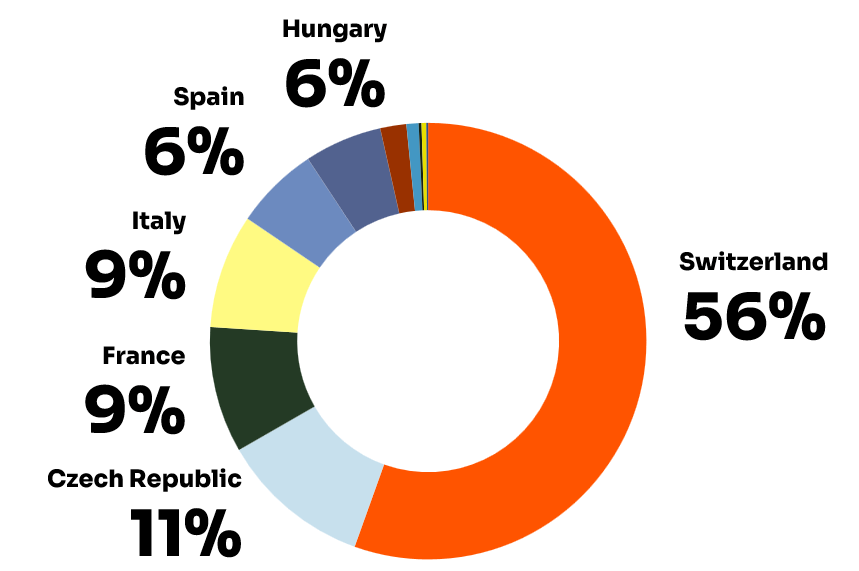
As per 31 December 2025, Alpiq has 1432 employees, split by geographical areas as follows:
Country | Headcount of employees |
Switzerland | 800 |
Czech Republic | 161 |
France | 126 |
Italy | 122 |
Spain | 90 |
Hungary | 83 |
Germany | 27 |
Finland | 13 |
Norway | 3 |
Sweden | 5 |
Bosnia | 2 |
Total | 1,432 |
Alpiq developed its corporate strategy in 2023, embedding sustainability as a core component. The company has set an overarching goal of achieving net-zero emissions for Scope 1 and 2 by 2040. In 2025, Alpiq advanced this commitment by preparing a transition plan that outlines the CO₂ reduction pathway towards 2040, as presented in the chapter Climate Change. Currently, more than 99% of Alpiq’s Scope 1 emissions originate from its gas-fired power plants. These assets therefore offer the greatest potential for emission reductions through optimisation and efficiency improvements. These plants play a critical role in ensuring system stability and reliable power generation – essential for Alpiq’s customers, including TSOs – and are expected to reach their end of life before 2040. Recognising their importance to both economic performance and energy security, Alpiq applies the “best owner principle” by continuously investing in upgrades that enhance efficiency and enable green gas blending. This approach is exemplified by optimisation and efficiency measures implemented at the Vercelli plant in 2024 and at the San Severo plant in 2025.
As mentioned previously, Alpiq offers its customers comprehensive and efficient services in the fields of energy generation and market access, as well as energy portfolio management and energy supply. These services are mainly offered to industrial and business customers throughout Europe. Thanks to digital tools and Alpiq’s expertise in flexibility management and cross-border trading, energy generation and asset trading are optimised to support the TSOs in stabilising the electricity grids. In addition, Alpiq supports customers in selling electricity from RES assets or in their efforts to reduce the environmental footprint of their own business activities. In France, Alpiq has also been active in the business-to-customer retail business for electricity consumers since 2020.
After explaining Alpiq’s strategy and business model, the following section focuses on the company’s value chain. As part of the DMA, described in detail at a later stage (see chapter Material Sustainability Matters), Alpiq’s value chain has been analysed in detail to identify IROs created throughout the entire value chain.
It is important to note that when referring to the value chain in the context of CSRD and the DMA, the term “value chain” is to be understood in line with the definition provided by the European Commission: “A value chain encompasses the activities, resources and relationships the undertaking uses and relies on to create its products or services from conception to delivery, consumption and end-of-life. Relevant activities, resources and relationships include: i. those in the undertaking’s own operations, such as human resources; ii. those along its supply, marketing and distribution channels, such as materials and service sourcing and product and service sale and delivery; and iii. the financing, geographical, geopolitical and regulatory environments in which the undertaking operates. Value chain includes actors upstream and downstream from the undertaking. Actors upstream from the undertaking (e.g., suppliers) provide products or services that are used in the development of the undertaking’s products or services. Entities downstream from the undertaking (e.g., distributors, customers) receive products or services from the undertaking.” (European Commission, 2023).
This use of the term “value chain” is not to be confused with Alpiq’s internal definition and use of the term, which refers to the elements that generate value for the company and includes the “value chain elements” Assets, Trading, and Origination. In order to avoid confusion with Alpiq’s internal use of the term “value chain”, these are referred to as “value chain elements” in the remainder of this chapter.
The complete Alpiq value chain looks as follows:
Share of Scope 1 emissions from gas power plants
>99%
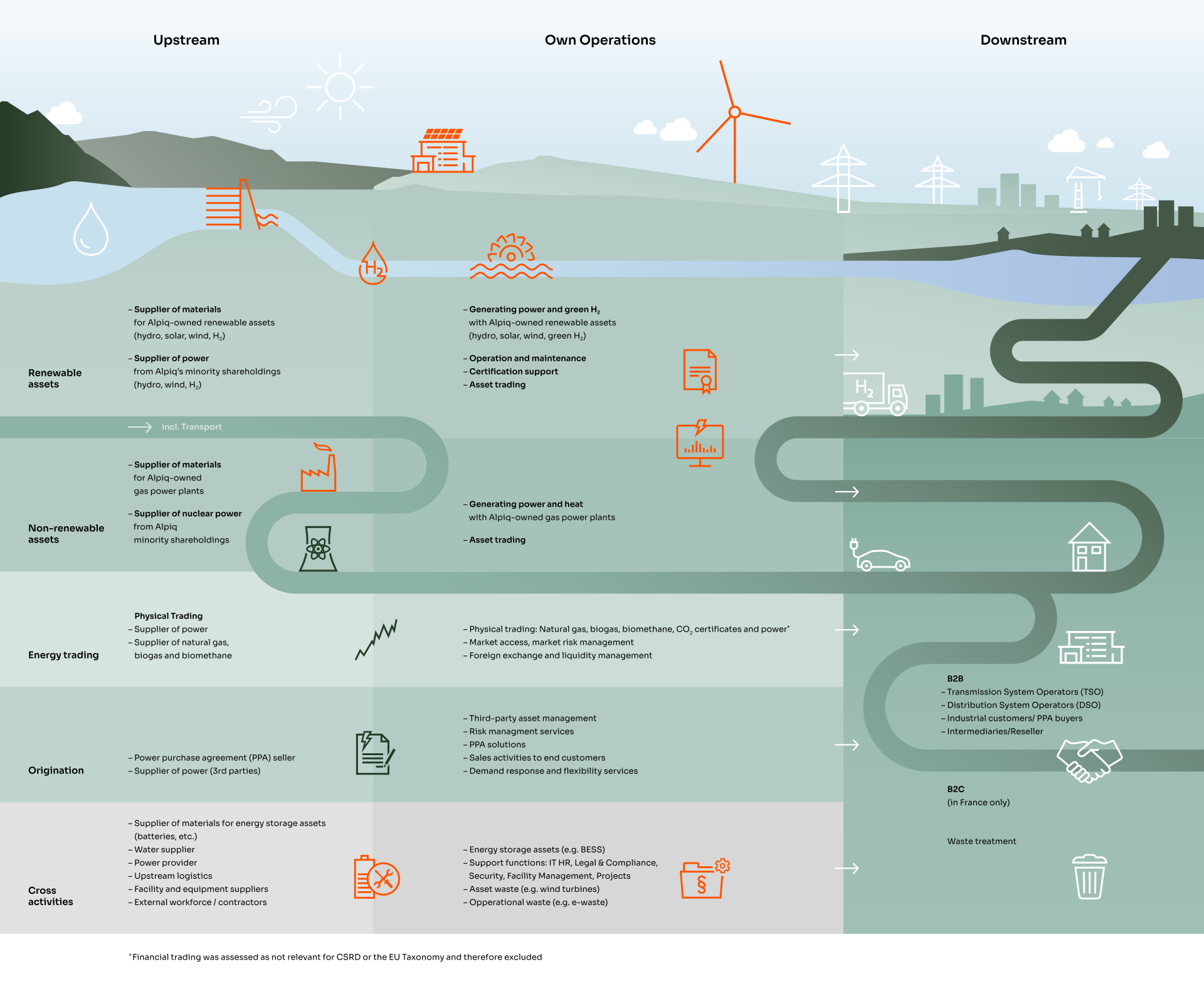
As shown in the above illustration, Alpiq’s own-operations part of the value chain contains the company’s three main elements of value creation – Assets, Trading, and Origination – as well as activities that span these three elements. The Alpiq value chain is completed by the upstream and downstream parts.
The upstream value chain consists of partner agreements with minority shareholdings for both renewable and non-renewable energies. Under the partner agreements in force, the shareholders of partner power plants are required to take on the energy and pay the annual costs allotted to their ownership interest throughout the concession period. Furthermore, nuclear power plant owners are required to pay certain additional contributions to the decommissioning and waste disposal fund, in case a primary contributor is unable to fulfil payments. The partner agreements run throughout the useful life of the power plant, or throughout the concession period, and can only be terminated under exceptional circumstances and with the unanimous decision of all parties. In some cases, the shareholding may differ from the right to energy and therefore from the obligation to pay the annual costs. In such cases, the reported interest from an economic perspective may differ from the interest held pursuant to corporate law. In addition, Alpiq’s upstream value chain entails some Trading and Origination activities. Upstream trading entails the physical trading of power, natural gas, biogas, and biomethane, while upstream origination entails mainly engagement in PPAs and the supply of power via third parties.
Similarly to Alpiq’s upstream value chain, the company’s own operations can be divided into activities belonging to the Asset, Trading, or Origination element, or to cross-element activities. Own-operations activities in the Asset element include power generation through renewable and non-renewable assets, as well as asset trading. The own-operations Trading element consists of the financial trading of fossil commodities, power and CO2 certificates, and the physical trading of natural gas, biogas, biomethane, CO2 certificates and power. Activities related to market access and market risk management, foreign exchange and liquidity management are also part of own-operations trading. Own-operations Origination activities include third-party asset management, risk management services, PPA solutions, sales activities to end customers, and ancillary services. Cross-activities include energy storage, support functions (IT, HR, Legal & Compliance, Security, Facility Management, Projects), asset waste management, and operational waste management.
Alpiq’s downstream value chain entails primarily the business-to-business sale of power to TSOs, DSOs, industrial customers and PPA buyers, as well as to intermediaries or resellers. In addition, it includes Alpiq’s business-to-customer retail activities in France.
Interests and views of stakeholders
ESRS SBM-2
Alpiq’s most relevant internal and external stakeholders are employees, shareholders, banks, customers, suppliers, business partners, associations, politicians and government groups, as well as civil society, including NGOs.
Stakeholder engagement has a high priority at Alpiq and takes place with all stakeholder groups via different channels and at various intensities and frequencies, depending on the specific stakeholder group and the situational circumstances. Dialogue with stakeholders, including shareholders, is generally conducted via the Chairman and the Annual General Meeting. The administrative contact is the Secretary of the Board. Furthermore, public affairs, investor relations, and other specialists in different departments and business units are dedicated to stakeholder engagement.
Internal stakeholder engagement is supported through various channels and platforms for informal and formal direct dialogue with and among employees.
As for the employee stakeholder group specifically, and in accordance with the Alpiq Code of Conduct and the company’s respectful and Secure Base Leadership-compliant behaviours, Alpiq adheres to the following principles:
- Provision of appropriate working conditions (compliance with applicable labour law at all times)
- No discrimination, and celebration of diversity (a dedicated Inclusion of Diversity team ensures that HR and workforce-related processes align with inclusion standards)
- No bullying and no tolerance for harassment (performance management weights and assesses performance equally according to results and expected behaviours)
The purpose of internal stakeholder engagement is to foster commitment and motivation, which are crucial for running a successful business. In order to understand employees’ interests, needs, and expectations, the Great Place to Work (GPTW) employee survey was conducted during the reporting period. The results of the survey were published in January 2026, and actions based on the results are currently being developed. Further details on the GPTW survey can be found in the chapter Own Workforce.
As for external stakeholder engagement, Alpiq is actively involved in professional associations through committees, commissions, and working groups, with the aim of working towards sustainable economic framework conditions for the Swiss electricity sector at political and administrative levels. The company is also in direct and continuous dialogue with political decision-makers (members of parliament, energy and environmental commissions) and government administration, with the aim of mitigating and minimising risks and uncertainties in the political process. Alpiq continuously monitors and analyses political events and intervenes in specific legislative proposals to secure good framework conditions in the long term.
In addition, Alpiq works closely with NGOs, particularly in infrastructure projects and regarding the mitigation of environmental impacts, e.g. compensation measures related to Nant de Drance, which have been implemented in collaboration with WWF and Pro Natura.
The interests and views of internal and external stakeholders were taken into consideration in the DMA. This was accomplished by conducting surveys and interviews with representatives of the relevant stakeholder groups in 2024. Based on the surveys sent out and the interviews conducted with stakeholders as part of the DMA, the interests and views of Alpiq’s stakeholders and Alpiq’s engagement with them can be summarised as follows:
Stakeholder | Interests and views | Engagement |
Employees | Fair compensation, career growth, job security, work-life balance | The internal contact to employees is guaranteed through various channels and platforms for informal and formal direct dialogue with and amongst employees. In Switzerland for example Alpiq has a personnel committee in place that represents the employees’ interests towards the management of the Alpiq Holding AG. In addition, regular surveys (e.g. Pulse checks and Great Place to Work surveys) are conducted, providing deeper insights into Alpiq employees’ interests and needs. Through various channels, e.g. through Alpiq’s SpeakUp mechanism, all employees can hand in cases of misconduct to be investigated internally by Alpiq’s compliance team. |
Suppliers | Reliable payments, long-term relationships | Alpiq’s central procurement team for Switzerland and Prague maintains regular dialogue with suppliers. The dialogues in the other Alpiq locations are maintained on a more decentralised level by our local Procurement specialists. |
Customers | Increasingly request sustainable business and clear commitment to reduction of negative impact on environment and society as condition for closing a deal | Customers were consulted in the creation of Alpiq’s Double Materiality Assessment and their interests are recorded and represented through Alpiq’s employees in Energy Solutions (formerly Origination; name change effective January 1, 2026). Alpiq’s SpeakUp tool is open to the public, allowing customers to hand in compliance concerns for internal investigation, as well. |
Business partners | Long-term relationships | An important business partner for Alpiq are the co-owners of the “Partnerwerke” constructs, pertaining mainly to Alpiq’s hydro power plants. A close collaboration and dialogue is maintained with said co-owners. |
Shareholders | Profitability, long-term growth | Dialogue is maintained via the Secretary of the Board and Annual General Meetings as well as through contact with the Board of Directors. In addition, shareholders were consulted in the creation of Alpiq’s Double Materiality Assessment. |
Banks | Financial stability, low-risk investments, increasingly interested in investing in companies with clear decarbonisation targets and paths | Dialogue is maintained through regular exchanges between the Lead Group Sustainability and key banks for Alpiq. Banks were also consulted in the creation of Alpiq’s Double Materiality Assessment. |
Associations | Advocacy for industry issues | Alpiq is actively involved in professional associations through committees, commissions and working groups with the aim of working towards sustainable economic framework conditions for the Swiss electricity sector at the political and administrative levels. |
Politicians/government groups | Regulatory compliance, environmental protection, ensuring security of supply (e.g. Federal act on a secure electricity supply in Switzerland) | Alpiq is also in direct and continuous dialogue with political decision-makers (members of parliament, energy and environmental commissions) and government administration with the aim of mitigating and minimising risks and uncertainties in the political process. Alpiq continuously monitors and analyses political events and intervenes in specific legislative proposals to secure good framework conditions in the long term. |
NGOs | Minimising environmental / social impacts, ethical business practices | Alpiq works closely with NGOs, particularly in infrastructure projects and in connection with the impact on the environment (e.g. close cooperation with WWF and Pro Natura in the area of compensation measures relating to Nant de Drance). In addition, NGOs were consulted in the creation of Alpiq’s Double Materiality Assessment. |
In addition to the stakeholder engagement activities described above, regular exchanges between the Lead Group Sustainability and various stakeholder groups (e.g. banks, investors, NGOs) take place to understand stakeholders’ interests and needs. The Lead Group Sustainability represents their needs in EB and NRSC meetings and provides support by helping to ensure alignment of the strategy with those needs. Some interests that have already been taken into account from these stakeholder groups include the following:
- Investors’ interest in reduced Scope 1 and 2 emissions, since these emissions appear in their Scope 3 balance.
- Banks’ increasing interest in companies with low CO2 emissions, as they have set thresholds to decarbonise their portfolios or accept gas investments only if there is a link to renewables development.
- NGOs’ negative perception of companies that operate with fossil fuels. This is a critical issue for Alpiq, since NGO support for new projects is essential. Alpiq took these interests into consideration when formulating the net-zero targets for Scope 1 and 2 as part of its strategic direction until 2040.
Stakeholders’ views and interests regarding the company’s sustainability-related impacts are provided to the BoD, EB, and NRSC by the Lead Group Sustainability in the form of regular written or oral updates.